
Artificial Intelligence

how to rank on google ai
Artificial Intelligence

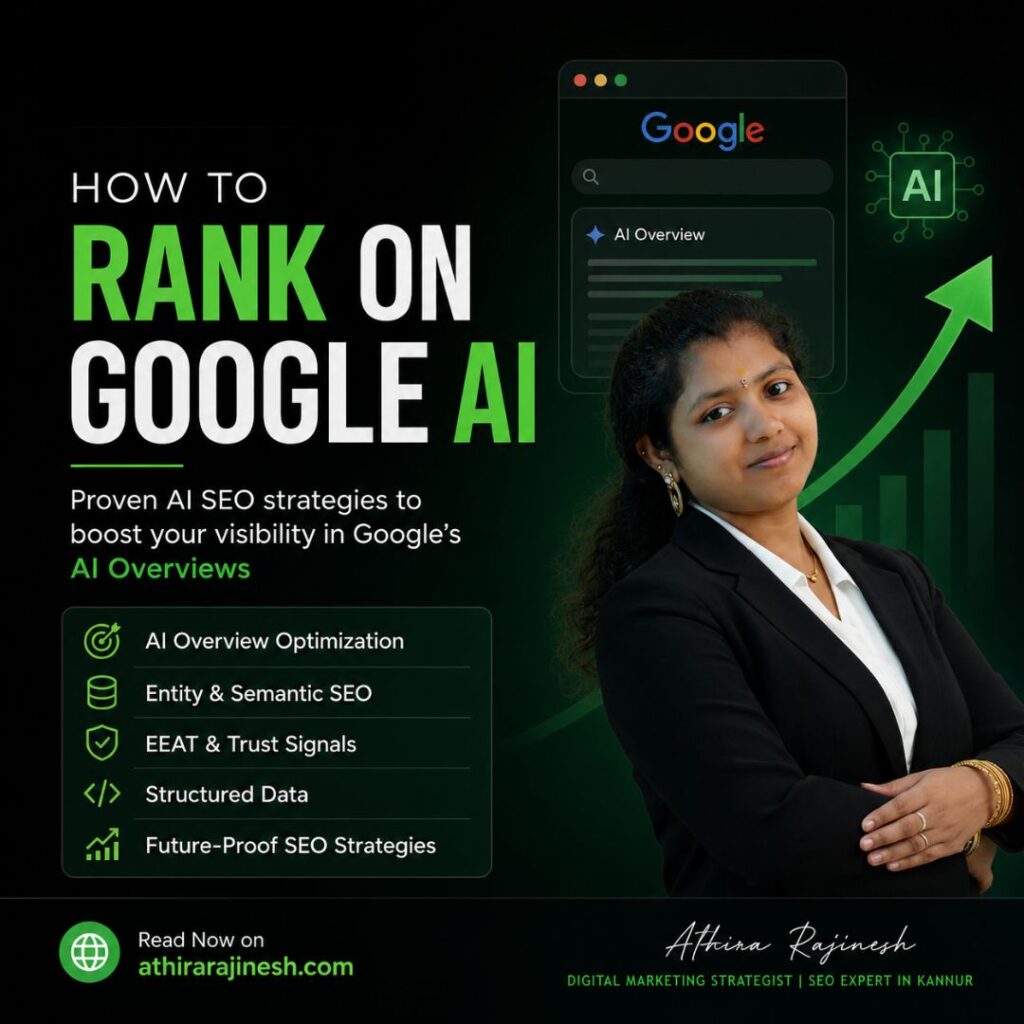
How to Rank on Google AI in 2026 | Complete SEO Guide

How to Rank on Google AI in 2026: The Complete Guide Google Search has undergone tremendous changes in recent times. Traditional blue links have been overtaken by other methods through which users can get answers to their queries. The use of Google AI Overviews has made it possible for search results to display answers to queries generated using artificial intelligence. This means that businesses and bloggers should adopt a different approach in their SEO efforts. If you want to know how to rank on Google AI and optimize your website on Google AI, you are at the right place. Here is a guide to help you learn about effective strategies to do just that. What is Google AI? Google AI means Google AI technology that understands the purpose of the query made by the user, analyzes content on the Web, and provides answers directly in the search results. No longer just ranking pages for keyword match, Google is now looking at: Content quality Expertise Authority Trust User intent Relationships between entities Semantics relevance All data from several trusted sites are used by the AI to provide an AI Overview. Being featured in the responses generated by Google AI greatly increases your website’s visibility and authority. Why Google AI Rankings Are Important Here are some advantages of SEO for Google AI: Brand awareness Trust from the user More traffic organically Higher quality leads Greater topical authority Higher likelihood of citations by the AI system The major difference between traditional ranking is that Google AI ranking values websites with more accurate information. Create Useful Content Google time and again has confirmed that useful content ranks better compared to search-engine-optimized content. Avoid keyword-stuffing. Answer actual user queries. The content should: Fix a problem Clarify any concept Contain examples Talk about the topic in detail Provide actionable tips Useful articles tend to be cited by Google’s artificial intelligence system. Gain Authoritative Status It is better to have a website that regularly publishes content on a niche. For instance, if your website is about SEO, publish content regarding: Technical SEO Local SEO AI SEO Keyword Research Link Building Google Search Console Schema Markup Content Marketing Once Google understands that you are an expert in that particular topic, it will trust you. Optimize for Entities Rather Than Only Keywords One of the major shifts in recent SEO practices is the use of Entity SEO. Google perceives people, places, businesses, products, and ideas as entities. Rather than using the same keywords repeatedly, join related topics seamlessly. For instance, while writing an article on Google AI, include: Google Search AI Overview Search Generative Experience (SGE) Semantic Search EEAT Structured Data Knowledge Graph Machine Learning By doing so, you’ll help Google’s AI get a better understanding of your content. Display EEAT EEAT means: Experience Expertise Authoritativeness Trustworthiness Google prefers articles by people who have relevant practical experience. To increase EEAT, consider: Adding a profile of an author Certifications Case Studies Original Screenshots References from credible sources Testimonials Updating articles regularly For freelancers and consultants, highlight your work experience and achievements. Use Structured Data (Schema Markup) Using structured data is essential in helping Google understand your website better. The important types of schemas include: Article FAQ Organization Person Local business Breadcrumb Review Service Structured data will increase the probability that your content is properly understood by Google AI. Answer User Questions Naturally In AI Overviews, Google pulls content that directly answers user queries. These should include: What is Google AI? How does Google AI work? How do I rank in AI Overviews? Is AI replacing SEO? Provide short answers before getting into details. Increase Content Readability Google AI understands content that is easily comprehensible. Use: Short paragraphs Headings Bullet points Tables Lists Pictures Infographics Always avoid using difficult language. Readability of the content increases engagement and boosts SEO results. Improve Internal Linking Internal links will help Google find related content and see how your website is structured. For instance: If you are writing on AI SEO, link to: Keyword Research Technical SEO Local SEO Content Marketing Schema Markup A well-structured website increases topical authority and improves user experience. Get Good Quality Backlinks The Google AI algorithm still takes into account backlinks as a key ranking factor. Here are some sources where you should get links: Industry Blogs News Websites Business Directories Educational Websites Local Business Associations Do not get spammy or low-quality backlinks that may have a negative impact on your website’s rankings. Quality plays a much bigger role than quantity. Update Your Website Regularly Google AI likes fresh content. Go through your articles once in a while and: Update stats Provide new examples Write about Google updates Delete outdated data Make your text readable Why Does Technical SEO Matter? Your website cannot rank despite having top-notch content if there are technical problems with the site. Optimizing: Core Web Vitals Responsiveness for mobile devices HTTPS security XML sitemap Robots.txt file Canonical tags Page speed Indexability Image optimization With technical SEO, Google will be able to crawl, index, and understand the website effectively. Mistakes To Avoid Most websites never show up on AI Overviews as they: Keyword spamming Posting thin content Failing to follow EEAT Lacking structured data Poor internal linking Copying competitors’ practices Not understanding user intent Ignoring technical SEO By avoiding these mistakes, you can drastically boost your chances of being noticed by Google AI. The Future Of Google AI SEO The technology for AI searches is rapidly developing. In the future, keyword density will matter less than value provided to the users. Businesses which will invest in semantic SEO, entities, topical authority, and useful content will be better off than others. Instead of adapting to algorithms, concentrate on building an authority website in your industry. Final Thoughts There are many reasons why it is now imperative to learn how to rank on Google AI. This includes making valuable content, improving your EEAT factors, using structured data, establishing topic authority, and entity optimization. With these, you will be
ai tools and traditional software
Artificial Intelligence

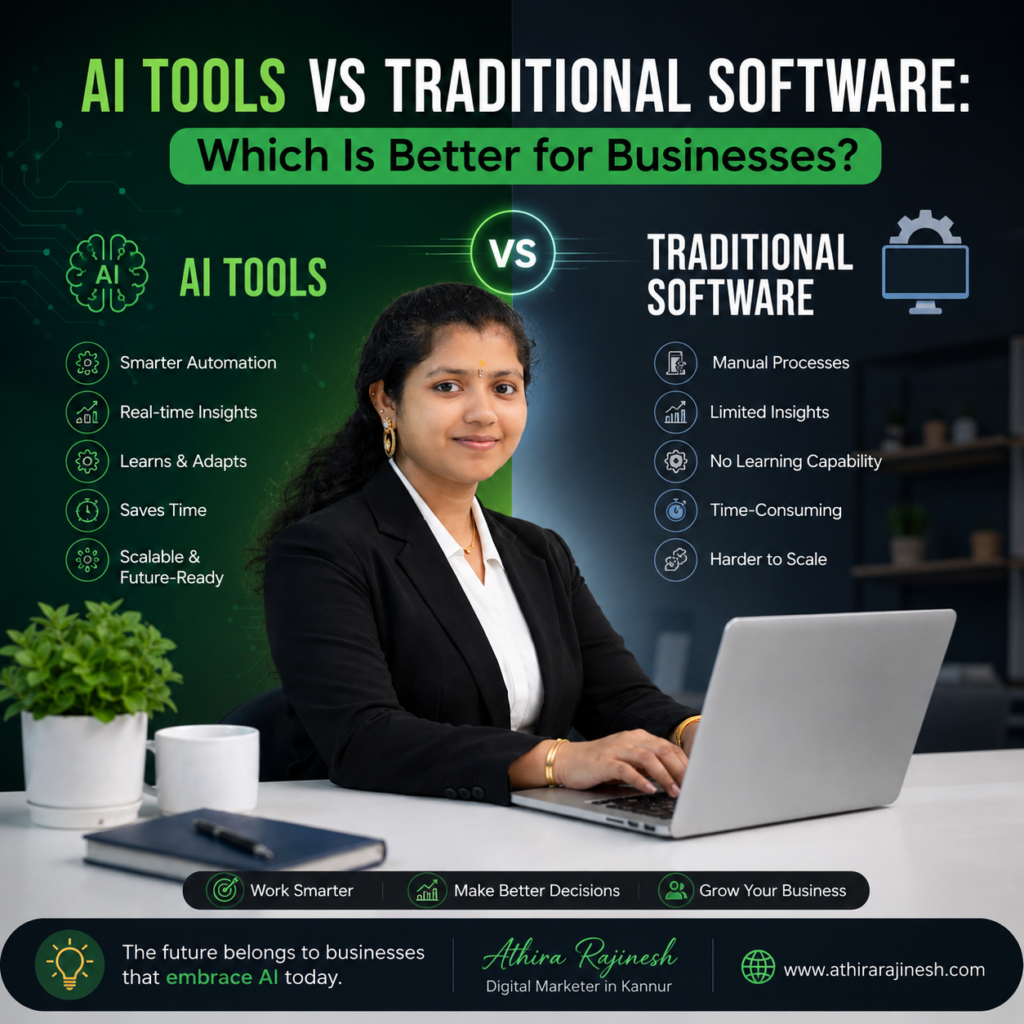
Compare AI Tools vs Traditional Software: Which Is Better for Businesses?

Compare AI Tools and Traditional Software: Which One Should You Choose? Technological advancement nowadays is growing incredibly fast, and businesses try to find some innovative ways to increase their efficiency and save money. One of the most topical controversies today is the comparison of AI tools and traditional software. Despite the long period of the usage of traditional software, AI tools have already transformed the processes of task automation, data analysis, and decision-making in the enterprise. Is AI replacing traditional software? Are there any distinctions between these technologies that make them unique and unable to replace one another? This article will help you find out which of these tools are more effective according to different criteria. What Are AI Tools? Artificial Intelligence applications are those that run on AI, ML, and NLP. What is distinctive about AI software in contrast with traditional one is its ability to learn, identify patterns, predict something, and even improve over time. They include: AI chatbots AI writers AI image generators Predictive analytics software AI customer service systems AI coders They minimize labor while increasing efficiency and accuracy. What Is Traditional Software? Normal software is constructed through programming logic that has been pre-defined. Every process within such software functions on pre-determined rules developed by the programmer. The software works only as it was programmed to do; however, it cannot think or learn. Some common examples are: Microsoft Excel Accounting software Inventory management software Payroll software CRM software ERP software AI Tools and Traditional Software: Major Differences 1. Ability to Learn Software developed traditionally is based on predefined instructions. AI tools keep learning from new information and get better at decision making. Winner: AI Tools 2. Automation Software developed traditionally is able to automate processes that can be programmed manually. AI tools are capable of automating both repetitive and smart tasks including: Answering emails Customer support Summarizing information Analyzing data Creating content Winner: AI Tools 3. Decision Making Software developed traditionally makes users decide on their own. AI software analyzes historical data, recognizes patterns, and suggests what to do next. Example: CRM developed traditionally stores data about customers. CRM developed by using AI technology predicts who is more likely to buy something. Winner: AI Tools 4. Flexibility Traditional software executes predefined functions. AI software changes according to new demands of businesses without regular need for updates from users. Winner: AI Tools 5. Speed Traditional software works at high speed yet relies on inputs provided by users. AI tools work with huge amounts of data and generate reports, summaries, and recommendations within seconds. Winner: AI Tools 6. Accuracy Traditional software works accurately if proper inputs are provided by users. AI tools learn continuously to become more accurate but can also make mistakes due to poor-quality data used during training. Winner: Tie (depending on how it is implemented) 7. Cost Traditional software is cheaper initially with no uncertainty concerning licensing. AI requires greater investments because of cloud computing, training of models, and expensive AI subscription plans. Nevertheless, AI often cuts down labor costs in the long run. Winner: Depends on business size 8. Maintenance Manual updating of software is needed when there are changes in the business rules for traditional software. The AI software evolves due to continuous learning and model updates but it also needs to be monitored and retrained. Winner: AI Tools Benefits of AI Tools Businesses are increasingly adopting AI because it offers numerous advantages: Automates repetitive work Saves time Reduces operational costs Improves customer service Enhances decision-making Generates business insights Personalizes customer experiences Boosts employee productivity AI is particularly valuable in industries handling large amounts of data. Benefits of Traditional Software Despite AI’s popularity, traditional software still plays a vital role. Its advantages include: Predictable performance Lower implementation costs High reliability Easier compliance Simpler maintenance for fixed workflows Better control over business processes Many organizations continue using traditional systems for accounting, finance, HR, and compliance. When Should You Choose AI Tools? AI software is ideal when your business needs: Intelligent automation Predictive analytics AI-powered customer support Personalized recommendations Content generation Image recognition Voice assistants Fraud detection Organizations focused on innovation often gain significant competitive advantages through AI adoption. When Should You Choose Traditional Software? Traditional software remains the better option if your organization requires: Fixed business workflows Regulatory compliance Stable operations Low implementation costs Minimal training Offline functionality For straightforward administrative tasks, traditional software is often sufficient. Can AI Replace Traditional Software? Not entirely. AI complements rather than completely replaces traditional software. Most modern businesses use a hybrid approach where traditional software manages structured operations while AI enhances decision-making and automation. For example: ERP systems handle inventory. AI predicts future demand. CRM stores customer records. AI recommends the best sales opportunities. Accounting software records transactions. AI detects anomalies and forecasts cash flow. Industry research from McKinsey & Company suggests that AI is most effective when combined with existing business systems instead of replacing them entirely. Final Thoughts There is no clear winner between the two. The only way to know which one is going to win is to determine the goals and needs of the particular company. Nonetheless, if your priority is automation, analytics, scalability, and efficiency, then the AI tools will outperform the traditional software. If, however, you prefer processes to be stable and predictable, then you need traditional software. In any case, the future belongs to those who will be able to implement both technologies. While the traditional software guarantees stability, the AI technology provides for intelligence and innovation. The companies that succeed in implementing both technologies will enjoy a competitive edge in the digital world. Frequently Asked Questions (FAQs) How does AI differ from conventional software? Conventional software operates based on set rules while AI learns from data, adapts to new data, and makes intelligent suggestions. Are AI tools more costly than traditional software? AI tools require more money to be developed initially, but they allow decreasing operation costs due to automation and efficiency increase. Is it possible to replace traditional software

Scroll to Top